
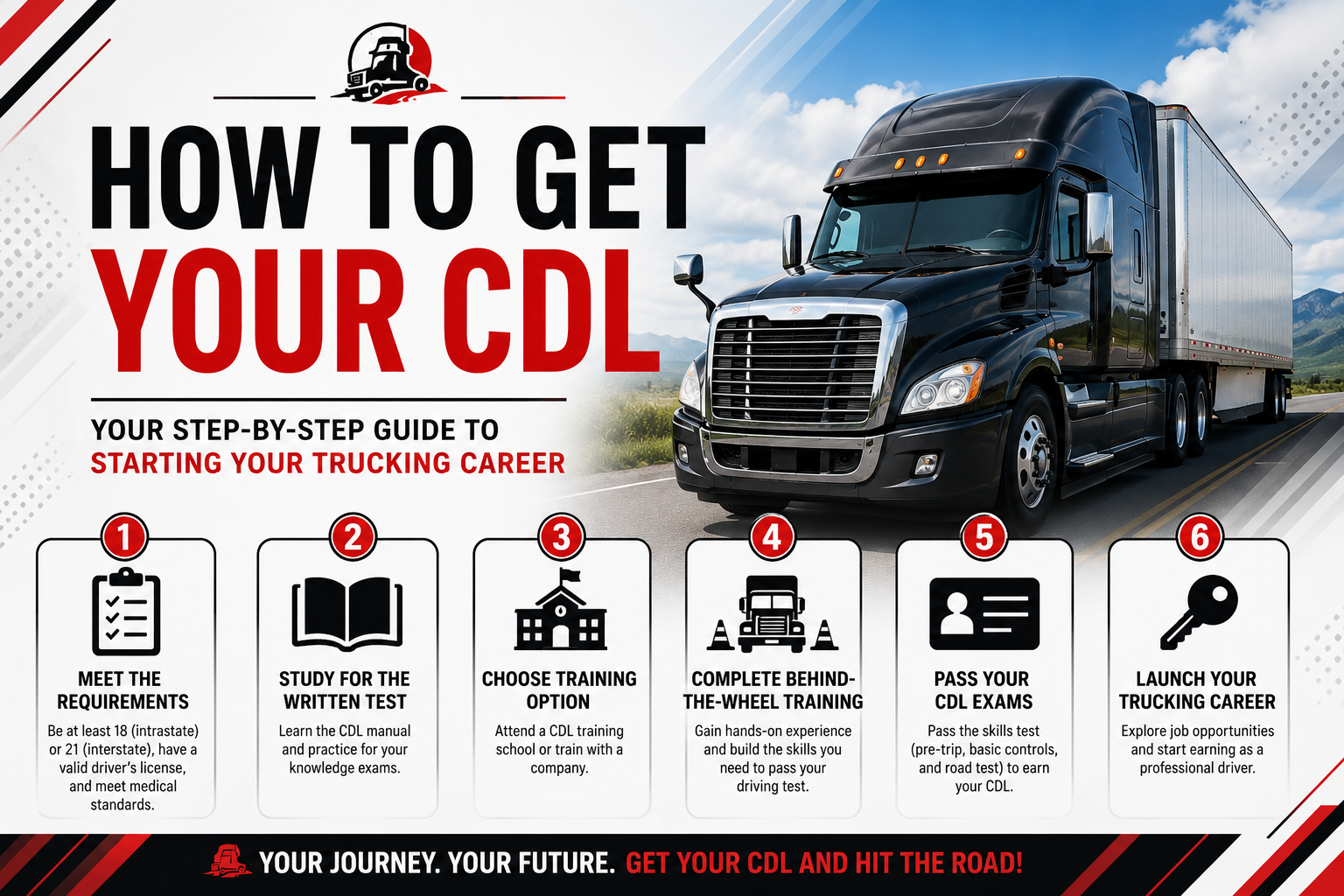
Getting a Commercial Driver’s License (CDL) can open the door to a wide variety of career opportunities within the trucking and transportation industry. Many drivers pursue a CDL because of the potential for strong income, travel opportunities, job stability, and long-term career growth.
For some drivers, trucking can become a financially rewarding career path. While pay varies depending on experience, freight type, location, and company structure, many first-year drivers can earn respectable income early in their careers. Team driving operations and specialized freight can sometimes increase earning potential even further because of increased miles and faster freight movement.
Understanding the CDL process ahead of time can help new drivers avoid confusion and prepare for each stage of training and testing.
What Is a CDL?
A Commercial Driver’s License (CDL) is a specialized license required to legally operate large commercial vehicles used for transporting freight or passengers.
Drivers with a CDL may operate:
- semi-trucks,
- buses,
- tanker trucks,
- dump trucks,
- delivery vehicles,
- and other commercial vehicles depending on license class and endorsements.
CDLs are regulated at both the federal and state level to help ensure commercial drivers meet safety and training standards.
CDL Classes Explained
There are three primary CDL classes in the United States:
Class A CDL
A Class A CDL is the most common license for over-the-road trucking and combination vehicles.
This license typically allows drivers to operate:
- tractor-trailers,
- semi-trucks,
- flatbeds,
- tankers,
- refrigerated trailers,
- and many other large combination vehicles.
Many long-haul and team driving positions require a Class A CDL.
Class B CDL
A Class B CDL is generally used for single vehicles that do not include large detachable trailers.
Examples include:
- dump trucks,
- straight trucks,
- cement trucks,
- buses,
- and certain local delivery vehicles.
Class C CDL
A Class C CDL is typically used for smaller commercial vehicles that transport passengers or hazardous materials in situations that do not fall under Class A or B requirements.
Class C licenses are less common in traditional over-the-road trucking.
Although there are only three primary CDL classes, drivers may also add endorsements to qualify for additional freight types or vehicle operations.
Minimum Requirements to Get a CDL
Requirements can vary slightly by state, but most drivers generally must:
- meet minimum age requirements,
- possess a valid driver’s license,
- provide proof of identity and residency,
- pass medical certification requirements,
- and maintain an acceptable driving record.
Drivers operating across state lines typically must be at least 21 years old under federal regulations.
Obtain Your Commercial Learner’s Permit (CLP)
Before obtaining a CDL, drivers usually must first obtain a Commercial Learner’s Permit (CLP).
The CLP allows drivers to practice operating commercial vehicles while supervised by a qualified CDL holder.
Obtaining a CLP typically requires:
- passing written knowledge exams,
- completing required paperwork,
- and meeting medical certification requirements.
Study for the CDL Written Tests
The written CDL exams cover topics such as:
- vehicle inspections,
- air brakes,
- combination vehicles,
- road safety,
- cargo securement,
- and general trucking regulations.
Many drivers study using:
- CDL prep books,
- online practice tests,
- CDL school resources,
- and state CDL manuals.
Proper preparation can significantly improve passing rates and reduce retesting delays. Many new drivers use the CDL Prep Plus Study Guide to prepare for written exams and endorsement tests. Having a structured study resource can help drivers learn key concepts faster, improve confidence on test day, and reduce the likelihood of retesting fees.
Attend CDL School or Training
Many drivers attend CDL schools to receive classroom instruction and hands-on driving experience.
Training programs typically cover:
- vehicle inspections,
- backing maneuvers,
- shifting,
- turning,
- defensive driving,
- and road operation.
Some companies also offer company-sponsored CDL training programs that help new drivers obtain their licenses in exchange for employment agreements.
Practice Driving and Maneuvers
Behind-the-wheel practice is one of the most important parts of CDL training.
Drivers usually spend significant time practicing:
- backing maneuvers,
- lane positioning,
- turning safely,
- shifting,
- parking,
- and pre-trip inspections.
The more comfortable drivers become during practice, the more confident they usually feel during testing and early employment.
Pass the CDL Skills Test
The CDL skills test typically includes:
- a pre-trip inspection,
- backing maneuvers,
- and an on-road driving test.
Examiners evaluate drivers on:
- safety awareness,
- vehicle control,
- observation skills,
- maneuvering ability,
- and compliance with traffic laws.
Passing all required portions of the skills test is necessary to officially obtain a CDL.
CDL Endorsements to Consider Early
Some endorsements can create additional job opportunities and flexibility early in a driver’s career.
Common endorsements include:
- Tanker (N),
- Hazmat (H),
- Doubles and Triples (T),
- Passenger (P),
- and the combined X endorsement.
Some endorsements are relatively quick and inexpensive to obtain because they may only require additional written tests.
Drivers interested in maximizing future opportunities should also read Best CDL Endorsements to learn which endorsements provide the most flexibility and earning potential
Company-Sponsored CDL Programs
Some trucking companies offer CDL sponsorship or company-paid training programs.
These programs may:
- reduce upfront training costs,
- provide guaranteed employment opportunities,
- and help drivers enter the industry faster.
However, many sponsored programs also require employment contracts or commitment periods before drivers are free to leave the company.
Drivers should carefully review all training agreements before enrolling.
How Long It Takes to Get a CDL
The timeline for obtaining a CDL can vary depending on:
- school availability,
- training schedules,
- state testing availability,
- and individual learning pace.
Some drivers complete the process in a few weeks, while others may take several months depending on scheduling and training requirements.
How Much It Costs to Get a CDL
CDL training costs can vary significantly depending on the school, location, and training structure.
Potential expenses may include:
- CDL school tuition,
- permit fees,
- testing fees,
- DOT physical exams,
- and endorsement testing fees.
Some CDL schools may cost several thousand dollars, although company-sponsored training programs may reduce upfront costs for qualifying drivers.
Common Mistakes New CDL Students Make
Many new CDL students underestimate how much studying and practice are required during training.
Common mistakes include:
- failing to study consistently,
- rushing backing maneuvers,
- becoming overly nervous during testing,
- neglecting pre-trip inspections,
- and failing to ask questions during training.
Drivers who remain patient, consistent, and willing to learn usually perform much better throughout the training process.
First Job Expectations After Getting Your CDL
The first trucking job is often a major adjustment period for new drivers. Drivers should understand that earning a CDL is only the beginning. Our ‘First Year Driver Expectations‘ guide explains what many new drivers experience during their first months on the road.
Many first-year drivers spend time learning:
- trip planning,
- communication with dispatch,
- time management,
- backing in real-world situations,
- and handling stressful road conditions.
New drivers should also understand that patience is extremely important during the early stages of a trucking career.
Is Getting a CDL Worth It?
For many drivers, obtaining a CDL can absolutely be worth the investment because it creates access to a wide range of career opportunities within transportation and logistics.
The trucking industry continues to play a major role in freight movement across the country, creating ongoing demand for qualified drivers in many sectors. If you’re still exploring long-term opportunities, our CDL Careers guide covers many of the different paths available after earning a CDL.
However, trucking also requires responsibility, adaptability, and long hours. Drivers should carefully consider the lifestyle and career expectations before entering the industry.
Final Thoughts
Getting a CDL can become the first major step toward building a long-term career in trucking and transportation. While the process may seem overwhelming at first, proper preparation and realistic expectations can make the journey much smoother.
Drivers who stay patient, continue learning, and build experience over time often create strong opportunities for income growth, specialized freight, and long-term career flexibility within the industry.
Ready to Find Your
Perfect Driving Partner?
Take our free Team Driver Compatibility Assessment to discover whether you and your potential co-driver are a strong match before hitting the road together.